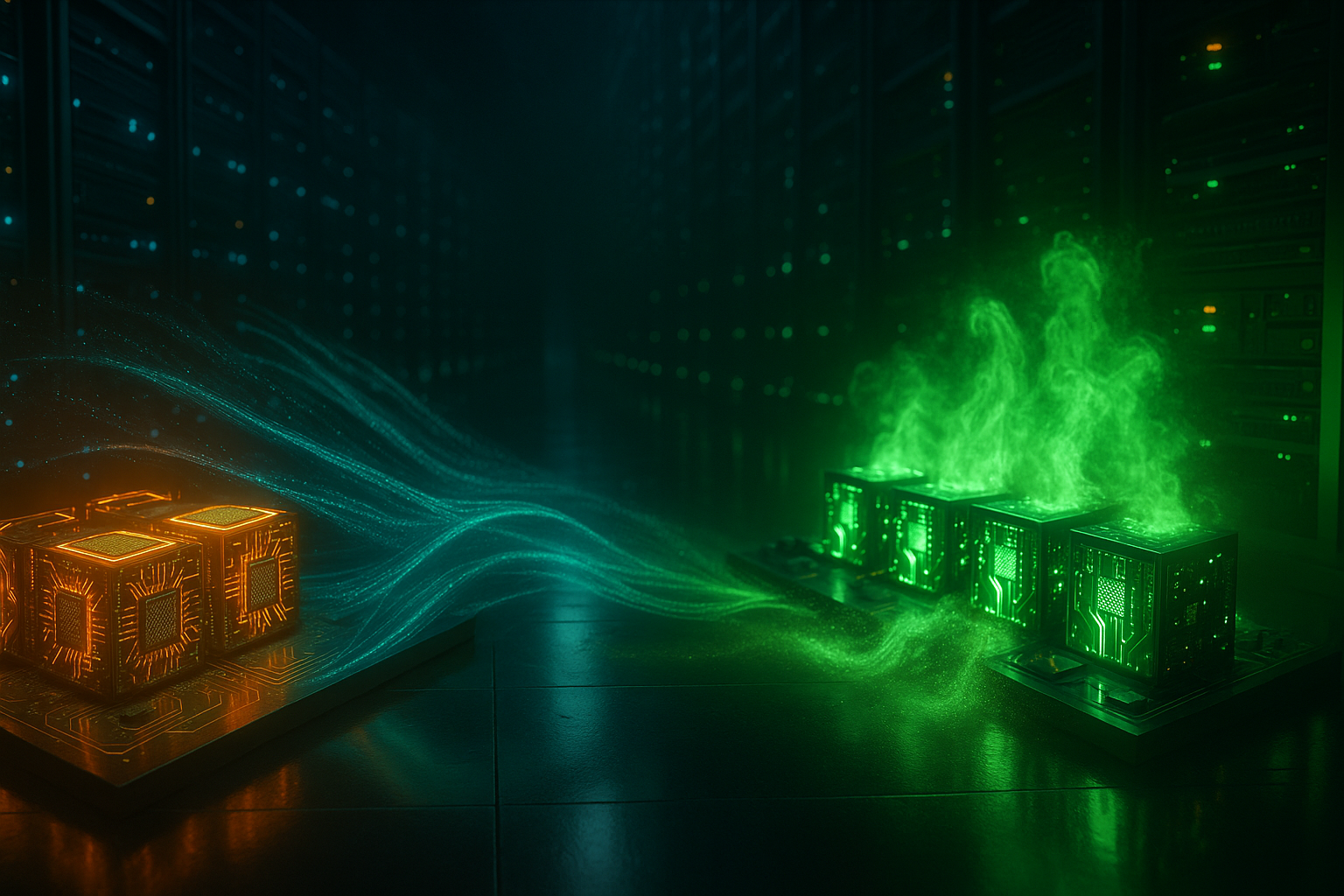
Amazon has officially launched Trainium3, its latest custom-built AI chip, signaling an aggressive push to challenge Nvidia’s grip on the artificial intelligence hardware market.
The new chip delivers 4.4x faster performance and 40% greater energy efficiency compared to its predecessor, while AWS simultaneously rolled out Trn3 UltraServers capable of handling 144 chips in a single system.
Customers like Anthropic, Karakuri, and Decart are already reporting training and inference cost reductions of up to 50% using Trainium3.
The move underscores a broader industry trend of tech giants developing proprietary silicon to reduce dependency on Nvidia’s GPUs and slash the astronomical expenses of AI infrastructure.
The cost revolution: How Amazon is undercutting Nvidia’s pricing
Trainium3’s real weapon isn’t raw performance; it’s economics.
Built on 3-nanometer technology, each UltraServer delivers 362 FP8 PFLOPs with up to 20.7 TB of HBM3e memory, enabling massive models to train in weeks instead of months.
But the cost angle is what captures enterprise attention. Decart, an AI video generation startup, is already achieving 4x faster inference for real-time video generation at half the cost of Nvidia GPUs.
For organizations spending millions monthly on AI infrastructure, that’s transformational economics.
Amazon’s strategy targets two pain points. First, the energy efficiency gap: Trainium3 delivers over 5x more output tokens per megawatt than previous generations, directly slashing data-center power bills.
Second, token cost. AWS claims Trainium and Google’s TPUs offer 50-70% lower cost-per-billion-tokens compared to high-end Nvidia H100 clusters.
For enterprises training trillion-parameter models, the cumulative savings reach hundreds of millions annually.
Anthropic’s early adoption carries symbolic weight; Amazon holds an $8 billion stake in OpenAI’s rival, yet chose Trainium for production workloads.
That endorsement signals Trainium3 isn’t experimental; it’s production-ready and competitive with Nvidia’s flagship offerings.
Can Amazon actually win?
Yet Nvidia’s moat remains formidable. CUDA, Nvidia’s software ecosystem, has become the industry standard for AI development.
Most researchers train models on CUDA; most frameworks optimize for CUDA first.
Switching to Trainium requires rewriting code, retraining teams, and accepting vendor lock-in with AWS, a daunting proposition for risk-averse enterprises.
Amazon acknowledges this reality by announcing Trainium4 will support Nvidia’s NVLink Fusion interconnect technology, enabling mixed deployments of Trainium and Nvidia chips within the same racks.
It’s a pragmatic admission that replacing Nvidia overnight is impossible, but positioning Trainium as a cost-effective complement is achievable.
Customer inertia also favors Nvidia. Enterprises with existing GPU infrastructure, trained teams, and optimized pipelines face switching costs that pure performance gains don’t justify.
Microsoft, Google, and Meta: Trainium’s biggest targets, also manufacture their own AI chips internally, reducing addressable markets.
Still, startups and cost-sensitive enterprises face no such incumbency burden.
Karakuri, Metagenomi, and Splash Music are deploying Trainium at scale, suggesting Amazon can capture new workloads even if Nvidia retains the prestige market.
The real question isn’t whether Amazon can match Nvidia’s raw performance; Trainium3 already does.
It’s whether cost and energy efficiency alone reshape a $50 billion+ AI chip market, or whether ecosystem lock-in and customer inertia keep Nvidia entrenched.
The post Amazon unveils game-changing AI chip: will it disrupt Nvidia’s dominance? appeared first on Invezz